In
the Spring of 2003, four educators in two continents put together an initial
effort at cross-cultural telecollaboration. The purpose of this site is to
summarize the story of their work thus far and to provide resources for other
educators wanting to make cross-cultural international connections.
Telecollaborative projects
1. Telecollaborative projects involve
- teachers and students working ...
- in some sort of cooperative fashion with other teachers and students ...
- over a distance, facilitated by electronic communications
- culminating in some sort of public product, perhaps published to the web for a larger audience to view.
2. Different levels and types of projects
- email
- CD's mailed back and forth
- videotapes or DVD's mailed back and forth
- Other artifacts mailed back and forth
- Published webpages
3. Sample project that Charlie Graham has participated in for
over ten years, initially via mail, but now facilitated electronically for
faster communication and wider distribution
- Travel Buddies-a website hosted in Australia which describes the project as follows:
"About
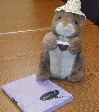
Travel Buddies Travel buddies
are soft toys or puppets that travel the world as representatives
of your class. They may go on a cultural exchange with a single
school or travel widely on a path chosen by those who forward
him to friends and relatives in other places. They go instead
of sending the children, an expensive and unrealistic proposition
for most schools."
Charlie's learning objectives for this project revolve around improved written
communication for his students and the social studies notion of "putting
a face on" the rest of the world for his students.
|
|

| Students
enjoy adopting the buddy for a day or a weekend, taking the buddy home, and
writing entries in the travel journal. These entries are regularly read aloud to the class.
Selected entries are emailed to the class using ePals,
an educationally friendly and safe email provider for classroom exchange. In some
cases further collaboration is facilitated through the emails including student
to student correspondence and classroom investigations. At the end of the
project the "travel
buddy" is sent back to its point of origin with many souvenirs and the travel
diary. Students eagerly await the arrival of their own travel buddy from
the other class.
|
The project usually lasts a couple of months, but occasionally extends to the full
year, depending on how well the classroom collaboration is going. In some rare cases the classroom on the other end has lost
interest and the travel buddy has not returned--one of the risks in trying
this kind of project. In terms of student achievement, all students seem
to
enjoy writing in the travel buddy journal. Each year Charlie sees about
three or four of his students (often some of those who are lower performers
in more traditional language arts assignments) do some of their very best
writing of the year in the travel buddy journal. Writing to
a real audience in the voice of a travel buddy
seems to a motivating assignment for all, with some particular advantages for some lower achieving students.
Structuring our telecollaborative project
1. Roots and Shoots
Roots & Shoots is the Jane Goodall Institute's international environmental
and humanitarian program for young people. Its mission is to foster respect
and compassion for all living things, to promote understanding of all cultures
and beliefs and to inspire each individual to take action to make the world
a better place for the environment, animals and the human community. All
Roots & Shoots members, from pre-K to university, demonstrate their care
and concern for living things through service projects in their communities.
Visit the Roots and Shoots Home Page .
Mark Bailey began working with Charlie Graham, a teacher in the Forest Grove School
district at Tom McCall Upper Elementary School. Charlie had established a Roots and Shoots group of which Mark's son was
a member. Mark was impressed with the work that was being done and wondered
if there was a way to share this work with a wider community. It was
at this time that he was able to confirm that he would be spending time in
New Zealand and in other parts of the world. He began to wonder if he
might be able to develop an international project that could foster connections
between roots and shoots groups. He established with the help of his son a Roots and Shoots--Tom McCall homepage which is hosted on the Apple Macintosh G4 server in the College of Education at Pacific University.
Charlie and Mark spoke about the possibility of this project. After confirming Charlie’s interest in this idea Mark contacted
the regional director of Roots & Shoots. It took some time to get confirmation
of their interest in the project (months) but eventually Mark received names
and addresses for a few Roots & Shoots groups around the world, including New Zealand.
At the same time Mark had located a school--Discovery 1--in
Christchurch New Zealand that he thought would be interested in this project
and others, and he enrolled his children for a term as well as volunteering
to help in the classroom.
So now the structure was in place.
- Two or more schools
- a topic of
interest (Roots and Shoots)
- Two facilitators: Mark in New Zealand, and Mike in
Forest Grove.
Prior to leaving, Mark began to document the work being done by the Forest Grove Roots & Shoots
group with the goal of working with his son to create an iMovie that
could be shared with individuals in other countries to encourage others to form Roots and Shoots clubs during their journeys.
2. New Zealand!!
When Mark arrived in Christchurch and began to work with the staff at Discovery
1, he identified the individual who would be most interested in being the
director of a new Roots and Shoots Project. Her name is Fiona Harman (a biologist
and teacher at the school). She had been working on a number of ecological
projects and was excited about linking up with the school in Oregon. She
became the sponsor for the brand new Roots and Shoots groups that formed
at Discovery 1 School.
What was needed next was a means for communication between the two school
and for swapping files. Mark began by setting up a .Mac account
that came with a shared 100MB hard drive space that could be used to upload
and download files to share. A second step in the process was to make
sure that students had permission to use email to communicate with students
in other schools. Charlie's students were already registered on ePals
thanks to his work with the Travel buddies project, and the students in new
Zealand had previously established access to email accounts as well.
Finally while in New Zealand I noted that the school had a server that was running
a program called “First Class” this would allow individuals to sign on and
to chat with each other live, as well as providing a shared file space
usable for exchanging photos and projects.
Student work
Two of the students in the club have composed an initial webpage
for the New Zealand Roots and Shoots club and edited a first iMovie video that portrays one of the activities that the club has begun.
The "shared project" between the two classrooms has become, for now, the
Roots and Shoots club, active in both places but not collaborating directly
at this point.
Roads to further collaboration
Once the tools were in place and the individuals were
interested, there was a need for the interests, schedules, topics and technical
resources to all come together. Both teachers already had other work
and projects underway as well as temporal commitments. And so any further
collaboration between the two classes began slowly. There have been a few
student to student correspondences, but nothing of substance as far as classroom
projects. The time frame was very short, and Fiona is just beginning to become
comfortable with digital technologies and concurrently to understand the
many ways to employ this tool to support student inquiry and learning.
Great momentum was developed during Mark's time at the school and we hope
that it will continue.
As Mark is just leaving New Zealand, he has been in contact with a teacher in Auckland who
already has a Roots and Shoots group established. She is also interested
in communicating with Charlie and Fiona, so maybe there is the possibility
to continue to spread this network.
In addition, Charlie has attended a national Roots and
Shoots gathering with some high school students that he works with. There
he informally presented the Roots and Shoots iMovie that his group had made.
He is particularly interested in the potential for using online tools for
further collaboration between Roots and Shoots chapters. He has also taken
advantage of our online checkout system at Pacific University's College of
Education to secure projection and digital cameras and camcorders to record
ongoing work with the Roots and Shoots group.
Resources for your own telecollaborative projects
Telecollaborative project examples with links to amazing K-12 online sample projects
Note that the point of all this
classification is not to define and label telecollaborative projects, but
to open the eyes of educators to the many different projects that have been
done by others and/or are available for educators to take part in.
- Wherefore Art Thou, Telecollaboration? an article in the International Society for Technology in Education's (ISTE) periodical available online at Learning and Leading with Technology (L&L)
type in the author's name--Judi Harris. Judi thoughtfully considers why so few teachers
engage in telecollaborative projects as well as providing excellent examples
of such projects together with the key to helping these projects flourish.
This article is available as a PDF file only for members of ISTE--I would
encourage you to join.
- Square of Life--this is the project that Charlie is embarking on
next with his students, though it is not one Fiona has subscribed to at this
point. Square of Life is
"an Internet-based collaborative project in which students will investigate
their local environment and share that information with other students from
around the country and the world." Students identify and investigate a one
square meter plot of their local environment and share the information back
with others on the web.
Telecollaborative project locators
Looking for the right project for your classroom? It will take some time
and energy to find it, and even more to carry it out, but in the end you
may find yourself providing a significantly better learning experience for
your students through your hard work!
Here are my recommendations for the best place to "shop" for an ongoing project that you can join:
- Global Schoolhouse.
"Global SchoolNet is the leader in collaborative learning.
We continue to provide online opportunities for teachers to collaborate,
communicate, and celebrate shared learning experiences.
- I*EARN.
"iEARN is a non-profit global network that enables young people to use the Internet and other
new technologies to engage in collaborative educational projects that both enhance learning and make a difference in the world."
- ePals--more than just an email service--see the projects section
"Over 4.5 million students and teachers are building skills and enhancing learning with ePALS. Established in 1996, ePALS has 79,249 classroom profiles bringing people in 191 countries together as cross-cultural learning partners and friends.