|
Important Figures of the American Revolution
Teacher Page A WebQuest for 5th Grade on the American Revolution Designed by: Jenae Carpenter carp1469@pacificu.edu 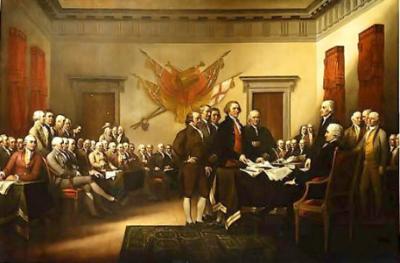 Introduction | Learners | Standards | Process | Resources | Evaluation | Conclusion | Credits | Student Page
This lesson was developed as part of an educational technology class at Pacific University. We were to choose a social studies topic and design a webquest based on that topic and a certain grade. My fifth grade class studies the Revolutionary War in the spring, so I decided to design a webquest that I could possibly use in the future.
This
lesson allows students to choose an important Revolutionary War figure
out of a list of 10 choices. They must then research the figure,
design a poster, write an investigative newspaper article, and give a
presentation. The presentation is a key part to the unit, so that
all students can learn about each person.
This lesson is designed specifically for 5th grade students, however, depending on your state benchmarks, it could be used in other grades as well. In Oregon, 5th graders learn about the Revolutionary War and the Constitution. Clearly, this is a social studies unit, but it also incorporates reading, writing, public speaking, art, and other standards discussed below.
Learners will
probably need to have some skills to complete this unit before
beginning, or at least learn them on the way including:
1) Experience using the Internet 2) Knowledge of newspaper format (Using columns, etc.) 3) Experience editing each other's papers 4) Experience with timelines 5) Experience with biographies 6) Prior knowledge about the American Revolution and the Revolutionary War, especially the causes of it and the two different sides (This webquest could be done within a larger American Revolution unit after the students have already started learning about the period) Many of these skills could be done as mini-lessons throughout the webquest. Curriculum Standards Many standards will be addressed within this webquest. Not every standard will be completely addressed, but some part of it is focused on during this project. Oregon Social Studies Standards Addressed
SS.05.HS.01 Interpret data and chronological relationships presented in timelines and narratives
SS.05.HS.01.01 Order events found in historical narratives
SS.05.HS.01.02 Calculate time and infer information from timelines
SS.05.HS.05.03 Understand the impact of individuals through the period of the American Revolution, on ideas, ways of life, or the course of events in US history SS.05.HS.05.05 Identify and understand the causes, course, and impact of the American Revolution, including the roles of George Washington, Samuel Adams, and Thomas Jefferson SS.05.SA.O1 Examine an event, issue, or problem through inquiry and research Oregon Arts Standards Addressed
AR.05.CP.O1
Use experiences, imagination, observations, essential elements and
organizational principles to achieve a desired effect when creating,
presenting and/or performing works of art
Oregon English Language Arts Standards Addressed
EL.05.RE.04 Listen to, read, and understand a wide variety of informational and narrative text, including classic and contemporary literature, poetry, magazines, newspapers, reference materials, and online information EL.05.RE.06 Match reading to purpose--location of information, full comprehension, and personal enjoyment EL.05.RE.17 Read textbooks, biographical sketches, letters, diaries, directions, procedures, magazines, news stories and almanacs EL.05.RE.18 Use the features of informational texts, such as formats, graphics, diagrams, illustrations, charts, maps, and organizational devices to find information and support understanding EL.05.RE.20 Follow multiple-step directions (e.g., fo completing an experiment or an activity or for using a product) EL.05.RE.21 Recognize and/or summarize sequence of events and main ideas presented in informational texts, identifying evidence that supports those ideas. EL.05.RE.22 Identify key facts and information after reading several passages or articles on the same topic EL.05.WR.01 Use a variety of strategies to prepare for writing, such as brainstorming, making lists, mapping, outlining, grouping related ideas, using graphic organizers, and taking notes EL.05.WR.02 Discuss ideas for writing with classmates, teachers, and other writers, and develop drafts alone and collaboratively EL.05.WR.05 Use the writing process--prewriting, drafting, revising, editing, and publsihing successive versions EL.05.WR.09 Edit and proofread one's own writing, as well as that of others, using the writing conventions, and, for example, an editing checklist or list of rules with specific examples of corrections of specific errors. EL.05.WR.11 Write multi-paragraph compositions that: -Engage readers with an interesting introduction -Present important ideas or events using organizational structures, such as sequential or chronological order, cause-and-effect, or similarity and difference -Develop new ideas in separate paragraphs -Provide details and examples to support ideas -Provide transitions to link paragraphs -Offer a concluding paragraph that summarizes important ideas and details EL.05.WR.16,17,18,19,20, and 21 (This project works on spelling, grammar, punctuation, and capitalization) EL.05.WR.30 Use organizational features of printed text to locate relevant information The students also get practice with public speaking and listening, which are part of Oregon standards Step 1: The students' first job is to choose a partner and then choose a historical figure from the list given. Of course, if you want to choose partners for them, or if you want to choose the figure for them, that is your individual choice. I limited the amount of groups that could study each person so we wouldn't have 75% of the students studying George Washington. One of the objectives of this lesson is that the students learn from each other, so there should be many different figures being studied. Step 2: After they've cleared the choice with you, their next job is to use this worksheet (which I will have printed off and handed out ahead of time, and gone over with them) to search the given websites for their particular figure. Each student has at least two websites to search through. This part of the lesson will take several class periods to complete. I would do this as a whole class activity in a computer lab. I'm estimating it will take probably three 45-60 minute class periods to complete. Step 3: Once they have gathered all their information, the next job is the poster. Because I've made this a partner task, I will need to give them time to complete it in class. If you want to make this an individual task, they could do it at home instead. I will probably give them one week of 30-45 minute class periods. They will need some more computer time to find pictures or look at timelines (probably one class period just for the poster in the lab). It is important to stress that they need to split up the work for the poster and monitor them to make sure they are doing equal work. Remind them that they will be reviewed by their partner and that it will affect their grade. If this is done in class, you will need to provide poster board and other supplies like markers and pens. Step 4: Once the poster is complete, the next step is to write the investigative article. This is an individual task. I would suggest having them write the rough draft in class and then having them switch with their partners to peer edit. Depending on what the students have been taught before, you may need to do some mini-lessons on peer editing and writing newspaper articles. (Or you could just have them write a typical essay) This would also take approximately one week of 45-60 minute periods. If you plan on using this newspaper format, then the final copies need to be done in class, which may extend the time period for finishing the project. Otherwise, you could let them type it up at home (if they have access to computers). Step 5: Next, the students must practice for their presentation. They will need to divide which partner is going to say what part of the required information, then they can go home and practice on their own. I would suggest giving them at least one class period to practice together however, after they have had time to work on it at home. Encourage them to have fun with it like dressing up or speaking in an accent. I would recommend giving them at least one week after finishing the article to practice and be prepared to give their presentations. Perhaps make the presentations either in the morning or at the end of the day and invite the parents to come and watch. Because the presentations are done in pairs, I think they could be completed within one class period, but two might be less rushed. Have the other students take notes during the presentations with a graphic organizer so they are learning about each figure as well. Step 6: The final class period of this webquest will be filling out a peer review for their partner. Remind them to take this seriously because it is part of their final grade on the project. Notes: This project is clearly quite time-consuming. It will probably take four weeks to complete or more. The students will need to have already begun to study the American Revolution before starting this webquest so they have a background knowledge of the reasons behind the war and the opinions of the different sides. It might be difficult to get computer lab time in your school, so I would recommend signing up for a spot very early on if possible. This is a huge project, so it will be necessary to plan out in advance when you're going to give them class time to complete everything. I anticipate the biggest problem with this webquest to be the time factor. Even though each individual part of the project is fairly straightforward, when you put it all together it might become a little overwhelming to pull off without some experience or a lot of planning! I really think it could be an amazing unit if planned out in advance and given the proper amount of time to complete!
Parent
helpers could be useful for the computer lab sessions, especially if
your students have very little experience using the internet or
computer in general. Also, you may want to invite parents to come
and watch the presentations. I would recommend planning the
presentations either in the morning or at the end of the day so that
parents who worked could also possibly attend.
In order to evaluate the students, I created the above rubric. The five areas of evaluation are the completion of the research, the poster, the article, the presentation, and participation/effort. I used the categories 2 (incomplete), 3 (developing), 4 (meets), and 5-6 (exceeds) based on the standard Oregon scale for grading. If you're in a different state or use a different system you may want to change that to fit your needs. For the research, I would be looking at the completion of the graphic organizer and to what degree is it completed. For the poster I would be looking at whether they had each required part. For the article, I would also be looking at whether they had each required part, and the quality of their writing. For the presentation, I would be looking for the required parts and if they clearly put effort into learning the information and practicing the speech. I wouldn't expect the presentation to be memorized, but definitely practiced a few times. Of course, a huge part of this project is learning about the American Revolution and the important figures of that time. However, many other standards will be addressed like art, writing, editing, public speaking, internet research, and reading (especially working on reading biographies and informational text). Also, students will gain valuable practice in teamwork, collaboration, and problem solving while working with their partner. This
project is huge and time-consuming, but will also be exciting and fun
for the students who get to complete it! I truly believe that students
who learn by exploring on their own are much more motivated! The
students will gain so much valuable experience. This webquest
truly is widespread and incorporates so many important learning
objectives.
Picture #1: Signers ***Special thanks to Natausha Lusk at Kealakehe Elementary School for some inspiration from her webquest on Revolutionary Figures. Permissions We all benefit by being generous with our work. Permission is granted for others to use and modify this WebQuest for educational, non-commercial purposes as long as the original authorship is credited. The modified WebQuest may be shared only under the same conditions. See the Creative Commons Attribution • Non-Commercial • Share-Alike license for details.Last updated on October 2007. Based on a template from The WebQuest Page |