|
Teacher Page A WebQuest for 4th & 5th graders Designed by Laurel Stewart Introduction
| Learners
| Standards
| Process
| Resources
| Evaluation
| Conclusion
| Credits
| Student
Page
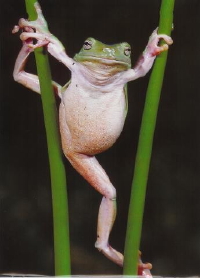
Frogs are a great learning companion to have in the classroom. They can open the doors to many topics to be explored by the class or individuals. This webquest will introduce your students to their new learning companion, a White's Tree Frog. Through guided Internet research, your students will learn about the natural habitat and lifestyle of the White's Tree Frog. They will research what it's environmental and nutritional needs are. Students will find that the White’s Tree Frog needs to have healthy, clean water, with a specific pH. They will discover the frog needs to live in a certain temperature range and type of climate. They will learn that for the frog to survive, the environment needs to be cleaned, and it is dangerous to use chemicals. The students will then need to evaluate the classroom and compare the needs of the White's Tree Frog to what is present in the classroom. They will need to decide what supplies are needed to provide an appropriate habitat for the White's Tree Frog to live healthy and happy within the classroom. The students will prepare a presentation to share what they have learned to the rest of the class. As "experts," students will be able to set up the portion of the habitat they researched and help plan for. The students will create a schedule for taking care of the White's Tree Frog's habitat and nutrition needs. The students will follow the care-taking schedule as a class. Many students will discover that frogs are an interesting animal to learn about, care for, and observe. The students might observe a behavior or pose a question they want to investigate further. The frog can be used as writing topics or starting points in mathematic lessons. Many of the science content standards can be addressed, starting with foundational knowledge gained by having a White's Tree Frog as a learning companion in the classroom. This lesson is designed for students in 3rd-5th grade levels. This lesson should come after students have been introduced to the principles of weather, habitats and nutrition. This lesson provides an opportuity for students to use their prior knowledge while researching specific information within those topics, to which they have been assigned. Since the students will be split into groups, it is important to ensure that at least one student per group is familiar with navigating the internet. Curriculum Standards: Technology Standards Addressed
Science Standards Addressed
English Language Arts Standards Addressed
In addition to the above benchmarks, this lesson incorporates team work and critical thinking. As a team, the students must take information they find through research and design a plan for creating this in their classroom. They must also combine with another group and compare their findings and come to an agreement on their presentation materials. This webquest was designed to have approximately 3 students per group. Two groups are assigned to each topic (food/diet, water/humidity, temp/lighting, plants/groundcover, handling/cleaning). After they research as a small group, they merge with the other group who shares their topic. They will then compare and combine their findings and create a presentation to give their classmates. Sizes of groups can vary to fit the needs of any classroom. Step 1: Split students into groups of 3. Each group will need 1 student who is familiar using the Internet. Instruct students to find their group's topic on the webquest and follow the instructions, working together as a group. Students will need approximately 2 hours to answer their research questions and document findings. This activity should be split into 2 (or more if needed) time periods. Step 2: Have each group join with the other group who shares their topic, making a group of 6. Students compare and combine findings. If there are discrepencies in findings, students may use internet to solve issues. As a group, students create presentation to give to the rest of the class. Tell groups their presentations need to include visual displays, answers to questions posed and list of supplies needed. Students will need approximately 2-3 hours to discuss and prepare their information for a presentation. This activity should be split into 2 (or more if needed) time periods. Step 3: Students give their presentation of their group's topic to the rest of the class. While students are watching each other's presentations, have them write down each group's shopping list. After all presenations, discuss shopping list and make revisions if needed. Step 4: After teacher has purchased needed supplies, have each "expertise" group set up the part of the habitat they investigated. Teacher Notes: Species Rationale: Commitment:
Variations: This lesson could be easily modified for any animal that could join a classroom as an education companion. This lesson could be arranged to fit any number of students and computers available.
This webquest is a great way to introduce a classroom companion, while taking the opportunity to have students practice skills in many areas. If you are considering getting a classroom companion, use the opportunity to have students research and plan the habitat to be created in your classroom. Image provided by: Smithsonian's National Zoological Park in Washington, D.C. Smithsonian Photo by Jessie Cohen. (c) 1992 Smithsonian Last updated on August 15, 1999. Based on a template from The WebQuest Page |
|||||||||||||||||||||||||||||||||||||