Philosophy of Education
WebQuest
Technology Grant Proposal
Student Teaching - 1st Student Teaching - 5th
My Lifelines
Family
Yosemite Hike Account by Patrick
Honma
Friends - under construction
Pets
Interests
Travel
From my Sketchbook
Philosophy of Education
My philosophy of education will always be a “work in progress”. The more I teach, the more I understand what education truly means, how children learn best, and who I am as a teacher. I am just beginning an unpredictable and exciting journey during which I’ll be learning from my students just as much as they will be learning from me.
Defining Education
The purpose of education is to provide children with a foundation of knowledge in all subject areas. In school, children should develop, in capability and character, to be the best they can be. This allows them to be fully contributing members of society. School must provide a place where a child can find a greater understanding of her own strengths and interests, as well as a healthy respect for others’. Because of its holistic nature, education should cover multiple dimensions of a student’s life.
Every person has different facets to their intellect and capabilities. By tapping as much of the child’s potential as possible, school becomes more interesting, valuable and just plain fun. Moreover, without a multi-faceted exposure, a child may miss developing his/her own capabilities. Even if a child has no particular talents physically or artistically, she can develop an appreciation and enjoyment for experiencing others’ performance of these activities --- something which will enrich the rest of her life. Teaching purposefully to accommodate different types of intelligences will be an important key to reaching more of my students. All students learn differently. If I can develop dexterity in flexing to the individual styles of my students, I’ll be a much more effective teacher.
Academically, students need to develop a basic knowledge of reading, writing, math, science and social studies at the level appropriate for them. They need these basics to be successful as they progress through the school system and into adulthood. In addition, I believe every child’s curriculum needs to include studies in art, music, physical education, technology and health. A well-rounded student is better equipped to succeed in whatever career they may choose or simply to live their lives effectively and with joy. The more fully developed individuals are in a society, the more enriched, exciting and forward-thinking that society is.
On a cognitive level, children need to develop proficiency and strategies in a skill they will employ the rest of their lives --- how to learn. Students must know how to synthesize new information effectively, make subjects relevant by relating them to their own lives and current knowledge of the world, and retain new concepts by transitioning them more efficiently into long-term memory. Besides the obvious practical benefits, learning in and of itself is a very satisfying activity.
Finally, a child’s schooling should teach her how to be happy and successful in society. School needs to be a place where children learn to cooperate, care for, and communicate with others. Indeed, for some of my students, the classroom may be the only place where they will feel safe enough to explore their own feelings, and listen and learn from their classmates and me. I’d like my students to learn to appreciate and respect the unique qualities of all individuals.
My Students
Students come to school with information and experiences which will affect how they will learn and how I should best teach them. Children are active participants in their own learning. New knowledge is gained from many sources including other people, experiences, and observations.
Students naturally compare new knowledge to what they already know, exploring until they can make sense of it. If the information has meaning or relevancy to them, they will incorporate it into their existing knowledge base, and long-term memory. Children synthesize new information continuously. It will be my job as their teacher to scaffold and assist them to make the necessary matches and mis-matches that lead to learning in the areas I outlined above.
I need to be aware of many areas of my students’ lives. This information will help me make informed decisions about how and what to teach them. These areas include:
1) General life experiences including socioeconomic status, family life, residences;
2) Emotional, meaning how they are feeling at any moment plus the residual effects of emotional experiences in the past: The stages outlined by Erickson will be useful to determine the challenges my students may be working through or be affected by because they had difficulty working through that stage;
3) Racial, cultural, religious characteristics and upbringing: My students will have their own cultural and lifestyle beliefs and behaviors I will need to respect and consider when teaching; and
4) Cognitive and learning styles: While obviously impossible and foolhardy to provide a different teaching style for each child in my classroom, it’s reasonable to set the goal of ascertaining how each pupil learns. By integrating a variety of teaching methods, I will be more likely to enable students with a wider range of learning styles to learn. An understanding of a student’s individual way of learning enables me to provide the best materials and lessons for them, making school a more enriching, fun and productive experience for that student.
5) Age: Students must be taught in developmentally appropriate ways for their age.
My Role as Teacher
My responsibilities are to provide a safe, comfortable and inspiring environment in which my students can learn, and to teach them the skills and knowledge they need to lead good, productive lives. I also have a responsibility to be a moral and behavioral role model. I need to leverage my particular talents and strengths to enhance my students’ learning experience. Therefore, I must be constantly aware of areas for improvement and my own feelings --- all of which may affect my teaching effectiveness.
Creating a great environment for learning will require knowing my students’ individual needs and strengths, understanding their backgrounds and lives outside of school, and being in touch with their feelings everyday. A child who is depressed, angry or just plain hungry will be hard-pressed to concentrate on learning. Whatever I can do to meet their needs, within the confines of my professional role and the rules of my administration or district, I will do. This may be the most important role I have. Whether or not I deal effectively with a student’s physical or psychological state could have an effect on the rest of their lives.
The first step to making my classroom conducive to learning will be to set up a strong community of mutual respect. We’ll talk a lot about what “respect” and being thoughtful look like throughout the year. Whenever possible, students will be empowered to make their own decisions, and solve their own problems --- as long as it causes no one else a problem, including me. This allows students to learn from natural consequences. It also gives the student a sense of control over his own destiny, increasing his/her self-esteem and confidence to handle life. It allows me to spend more time teaching versus disciplining. While no one really can control another human being, I can certainly serve as a guide and consultant, helping students reach good decisions on their own. Since I am ultimately responsible for setting up a productive environment, I will jump in to make final decisions as necessary, without invalidating the feelings or ideas of my students. I plan to be firm and consistent in applying the rules of the classroom, and model clear communication and fair dealings. I will work hard to always treat every child the same no matter their physical appearance or capabilities.
As appropriate, I will share about my own life so my pupils can experience me as a real person and learn through my experiences. Part of being a real person is making mistakes and not knowing all the answers. When I do not know something, I will admit it, and will ask the students to help me find the correct answer. I will certainly apologize for a mistake that negatively affects any individual. I plan to laugh a lot, surprise them often, wear costumes, sing with my class, and give them permission and opportunity to do the same. Students learn best when they feel safe, comfortable and engaged.
Once a great environment and community is in place, learning can begin. I obviously will need to work with the approved curriculum of my state/district/school. From there, I’ll engage a variety of teaching methods. As much as possible, depending on the subject and student audience, learning in my classroom will be active and student-directed. Engaging students in their own learning means they retain more information, enjoy school more, and help each other, building a stronger learning community in the process. I’ll be learning from their unique perspectives, and tweaking my approach in response to their struggles, successes and feedback. Admittedly, there are some subjects which require rote memorization like learning the multiplication tables or significant dates in history. It is unrealistic to teach every subject in every classroom in an active learning way. Sometimes time or other restrictions dictate expository teaching methods utilizing lectures, worksheets, rote memorization, drills and written tests.
When appropriate, technology will be incorporated in my planning and teaching methods, as well as the students’ learning experience. As far as teaching, utilizing the Internet, productivity software applications, and multimedia programs will enable me to stay organized, informed, and able to provide interesting presentations for my classes. There are unlimited amounts of resources on the Internet for teachers to share their ideas and projects with other teachers. Taking advantage of tried and true lessons and materials makes great practical sense, especially as I am just starting out.
Technology in the classroom is an absolute must for the current generation of elementary students. They were born into the computer age. They do not have a concept of the world without computers --- in almost every area of life. As a result, elementary students have a strong comfort level with technology, and expect and need to experience as much of it as practical. When laptops, desktop computers, camcorders, and digital cameras serve to meet learning objectives, they become very powerful teaching tools. Technology will be included if it means a more meaningful and effective learning experience for my students. Since my responsibility is to enable students to be successful in the world, teaching technology skills is absolutely necessary. I will also be modeling and teaching proper behaviors around technology use. Depending on the grade level, these would include how to properly handle computers and peripherals, copyrights, and software licensing. E-mail and instant messaging etiquette will be taught. This will hopefully prevent my students from becoming either victims or perpetrators of cyberbullying or online solicitation. In my classroom, students’ use of the Internet will be strictly monitored.
Leadership roles for duties like leading songs, taking out the ball basket, and passing out papers will be rotated regularly to give all my students a chance to be leaders. My students will be sharing their own interests, culture and families through their work and specific community-building activities. This way they will be experts on occasion, and will learn to appreciate their classmates’ talents and perspectives.
Because all my students will be elementary school age, they will require physical activity at regular intervals during the day. My classes will never sit for an entire morning or afternoon without a recess or activity of some kind. That could be something as simple as taking a walk together around the block, hopping from the rug to their desks, or participating together in learning activities requiring physical movement.
Conclusion
My philosophy of education will be evolving for the rest of my teaching career. An evolving philosophy is not only positive, it is necessary. I will be continuously evaluating my own effectiveness, and making changes to improve my teaching and classrooms for my students’ benefit. Changes in my philosophy will reflect on-going improvement of my teaching skills, and demonstrate my continued commitment to being the best teacher I can be. (rev. 3, 12/9/05)
Where my education began:
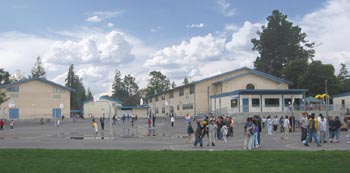
Elementary School:
Selby Lane School, Atherton, CA