Philosophy of Education
WebQuest
Technology Grant Proposal
Student Teaching - 1st Student Teaching - 5th
My Lifelines
Family
Yosemite Hike Account by Patrick
Honma
Friends - under construction
Pets
Interests
Travel
From my Sketchbook
Technology
Grant Proposal
This project synopsis is provided to support the formal OTEN Grant request of the student teacher/mentor teacher team of Cindy Honma and Ken Lowther. This team is requesting a mini-grant of $500 for the purchase of a Canon Mini DV digital camcorder for immediate use in their classroom. The camcorder will be a tool to support enhanced, personalized learning experiences for the students in the class. The teaching team with selected students will share their projects at the April 2006 OTEN Conference. The camcorder will remain with Ms. Honma after conclusion of this school year.
Overview of School and Student Population
The Honma/Lowther team works with a class of 23 fifth-graders at Tom McCall Upper Elementary School (TMUES) in Forest Grove, Oregon. The makeup of TMUES’ student population qualifies the school to receive Title 1 funding and services. Of the 29 students in the class, approximately 10 have been identified as Title 1 qualified, and receive the services associated with this designation. Therefore, over one-third of the class may only have access to technology equipment at school.
At this time, technical equipment regularly available for use in this classroom includes 2 desktop PCs, 1 Tablet PC, and 1 Apple Macintosh eMac computer. Through Tom McCall’s school resources, the teaching team may also reserve two carts holding a total of 16 laptops, one camcorder, and a SmartBoard for classroom use.
Description of Project
The project for which the camcorder will be engaged is part of a WebQuest learning unit on the animals of the Tropical Rainforest (http://education.ed.pacificu.edu/sweb/cindyhonma/index/htm). This WebQuest will likely be taught in February 2006. During this WebQuest, each student will be assigned a particular animal to research on the Internet. After locating key information about their animal, they will be teaching other members of a 4- to 5-person team about their animals. The entire team will prepare a skit to be presented to the entire class either live or as a videotaped movie. The skit must accurately depict and / or describe the characteristics and habitats of their animals. Examples of acceptable movie/skits include a town meeting where the animals present their cases for preservation of their habitat; a panel of Rainforest animal “experts” discussing their lifestyles and inter-dependence, a news story where animals are interviewed while facing a serious threat to their unique environment, etc.
The camcorder will be provided for the students to use in this project. It could be deployed in several ways:
1) Film a portion or all of their lessons to their teammates on their respective animals
2) Critique their understanding of their animals, and ability to communicate this information, by reviewing their own videotapes
3) The finished movie will demonstrate their team’s collective understanding of their assigned animals
4) Allow students the opportunity to learn and manage several roles around filming a short movie including acting, directing, and filming their colleagues.
5) Having the camcorder will provide opportunities for students to learn advanced multimedia applications on the eMac in their classroom. Utilizing the two tools together will allow students to create a movie from start to finish on their own. It also teaches them how to utilize technology in a coordinated fashion, a skill which will serve them well as they move out into the more eclectic technology world of higher education and work.
6) The camcorder will also provide Mr. Lowther and Ms. Honma another way to authentically assess the students’ progress for the remainder of the year --- in this project and others. Reviewing a student’s filmed work will provide invaluable insights into his/her level of subject knowledge, higher-order thinking capabilities, and areas for improvement.
Mr. Lowther and Ms. Honma will support the students with training, trouble-shooting, brainstorming, and assisting in the processes as appropriate. They will also keep the students on task for optimal learning. Mark Bailey will likely provide classroom training to enable the students and teaching team to ramp up quickly on the camcorder and eMac usage. Although there is benefit to free exploration of technology, introductory lessons jumpstart students’ learning so technology tools become valuable teaching aids more quickly.
Educational Justification
Education involves more than the transmission of content material from teacher to student. Students also must learn: 1) how to apply new knowledge; 2) a variety of learning strategies they can utilize for the rest of their life, in or out of formal learning environments; and 3) skills required for them to be successful in their future careers.
Technology, when used appropriately in the classroom, provides endless opportunities for students to apply knowledge in new and profound ways. For our Rainforest project, students will have several opportunities to communicate their understanding of the subject matter. This includes teaching classmates, writing, staging, starring in, and filming a short movie, and editing the movie. Since each student will be an active participant in all these activities, they will synthesize information throughout the project. Having a camcorder available for movie-making provides another way for students to teach about their animals and apply their knowledge in a meaningful way. The students viewing their movie will be presented information in a format they are more likely to attend to and enjoy which makes learning more accessible. Students retain information better if they are asked to apply this information in other contexts. Also, the more ways information is presented, the more likely it is to be filed in long-term memory, and retrieved later.
Through deployment of technology, a student’s concept of “how to learn” widens. Students begin to conceptualize learning as “outside the box” of books, lectures, worksheets and tests. Through the movie-making experience, learning and communicating what they learn becomes an active endeavor over which they have control and can gain mastery. Expressing their ideas artistically will ideally change our students’ attitudes about art for the rest of their lives. They will have a heightened awareness of and interest in deeper meaning in all modes of expression.
In this computer age, children come to school with an appreciation and comfort level with technology. Technology is fun! Therefore, adding it to the classroom makes learning more enjoyable. When learning is fun, students are more engaged and more likely to learn.
Finally, schools have a responsibility to prepare students for higher education and work. As technology becomes increasingly pervasive in almost every career, the student with technical skills has a greater likelihood of success in life. Making technology available to students, particularly those from a lower income bracket, gives them a competitive advantage in school or careers not otherwise available to them.
Where my education began:
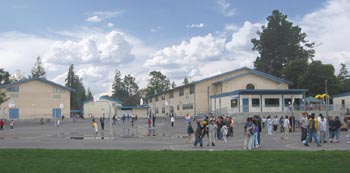
Selby
Lane School, Atherton, CA